Wednesday, January 15, 2014
Visual Cues - Kristin Dibler
High Contrast Materials -
lights up materials placed on the box for students with attention difficultiesVisual Learner
Visual Learner - Jackie Steer
If you are a visual learner, you prefer
using images, pictures, colors, and maps to organize information and
communicate with others. You can easily visualize objects, plans and outcomes.
This is the Early Childhood Task List. The students are able to identify the tasks that they have accomplished and see the ones that they still need to work on. It is a visual tracking guide for them.
The preschool early learning standards are located on the walls for the students to refer back to when they are developing their lesson plans. They also have the preschool standards books to use as a reference.
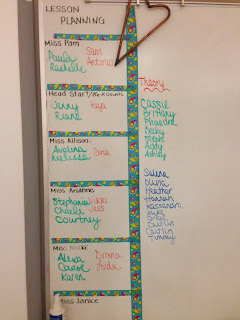
Every morning I list on the white board what they need for the day. Their journal is listed on the board, their task number from the task list, the objective for the week, and what the theory members and the field member need to turn in that week. The picture on the right shows the preschool classrooms and the students that will be in field for the two week rotation.
In my classroom, I provide many visuals for these types of
learners. Front and center of my white board, the students see their Task
number from their Early Childhood Task List and the objectives they will be
learning while exploring the chapter. Each morning we have a specific warm-up
for each day of the week. Everyday the students know what their journal will
be. I also list the theory work for them to accomplish throughout the time they
are in their theory rotation. On the other side of the board, I have listed
each preschool teacher and the students that will be rotating for those two
weeks. In a pocket chart, students will find all the necessary papers they are
required to fill out for field. I also keep missed work for absent students as
well as enrichment activities in there if a student would like extra work. The
two bulletin boards in my room have information regarding their program,
Students Occupationally and Academically Ready (SOAR) as well as important
dates they need to be aware of. The other bulletin board is to show case the
student’s hard work and effort on projects. The early childhood standards for
preschool are hanging up around our room so they can always refer back to them
when they are developing their lesson plans. Open-ended questions are listed
above my white board for the students to keep in mind how to increase language
comprehension in the preschool children.
On one corner of the room you can find a vocabulary word
wall that has the vocabulary words and chapters the words come from. On the
back is the definition of the vocabulary word.
Students are encouraged to test each other in a vocabulary review game.
We take advantage of the fact that we have mac laptops and
Ipads in the classroom. These tools help the visual learners design and create
lessons and projects. I try to
incorporate youtube videos that relate to what they are learning about.
When we take notes, I either have a powerpoint with guided
notes or I use the ELMO in the classroom to project important information. When
we go over our math journal every Wednesday, I have students come up to the
white board, smart board, or ELMO to show the class how they solved their
answer.
One of the most important visuals is the preschool classroom
itself. The students take on the role of a teacher assistant and have to scan
the classroom for behaviors, student needs and requests.
Other things to take into account for visual learners are:
·
Add diagrams to your notes whenever
possible.
·
Dates can be drawn on a time-line
·
Organize your notes so you can
clearly see main points and supporting facts and how things are connected.
·
Connect related facts to your notes
by drawing arrows.
·
Color-code your notes with
highlighters so that everything related to a topic is the same color.
·
Use color, layout, and spatial
organization in your associations, and use many 'visual words' in your
assertions.
Tuesday, January 14, 2014
An Example of a Multi-sensory Lesson
This lesson demonstrates how a multi-sensory approach can be used to teach a single lesson. Pay attention to the beginning because the students are singing a song as they transition to sitting in a circle for the math activity. The children clearly have been instructed how and when to respond to their teacher.
Auditory Cues
Students often benefit from auditory warnings and auditory cues built into a daily routine.
Transitions
Give a 2 to 5 minute warning prior to a change in the schedule- a timer, a bell, a special song
Give a signal when it is time to start an activity- clap your hands, ask students to repeat a phrase
Have a special auditory signal for the beginning or end of the school day
When traveling to different activities sing a song such as the Ants Go Marching
Learning Songs
Circle Time- a morning greeting song, a routine song or rhyme to start the day, sing the days of the week
Math and Reading- the alphabet song is an excellent example of an early reading song, there are numerous counting songs available, and even multiplication rhymes if you search for them! School house rock is still around!
Social Studies and Science- throw in some key sounds in Science during experiments, find a song for the water cycle, etc.
Unstructured Times
Have calming music playing during nap or indoor play time
Have an auditory signal to indicate when the class is getting too noisy
Have an auditory signal when the whole class attention is needed
This is a great explanation of how to teach your students how to respond to an auditory signal. Remember that just because you are using a signal at a certain time, doesn't mean that your students understand how to respond to it. It involves direct instruction.
Combining Art, Music, and Movement
This is likely an activity that is geared more towards the preschool age student or early elementary student. However I suppose that variations could be made to use it with older students.
I love this activity to combines art, music, and movement. It is a musical chairs game with the use of art. This a great way to not only teach students about different art concepts such as texture and concept but also allow students to move and burn some energy! This version does not eliminate a player, which is great for allowing students to work together as a team.
During the winter months I love to pull several students together for a social skills group to build Frosty the Snowman. I hand out the parts of Frosty and we sing a song to build Frosty. If you are familiar with the song Mat Man (to the tune of the bear went over the Mountain), I typically sing the song as "Frosty has one nose, one nose, one nose, Frosty has one nose so that he can freeze". I end every verse with so that he can freeze. I hand out the parts of Frosty to different students. As they build Frosty, they need to request the items from another student. It allows them to work together and they often love singing the song.
I love this activity to combines art, music, and movement. It is a musical chairs game with the use of art. This a great way to not only teach students about different art concepts such as texture and concept but also allow students to move and burn some energy! This version does not eliminate a player, which is great for allowing students to work together as a team.
During the winter months I love to pull several students together for a social skills group to build Frosty the Snowman. I hand out the parts of Frosty and we sing a song to build Frosty. If you are familiar with the song Mat Man (to the tune of the bear went over the Mountain), I typically sing the song as "Frosty has one nose, one nose, one nose, Frosty has one nose so that he can freeze". I end every verse with so that he can freeze. I hand out the parts of Frosty to different students. As they build Frosty, they need to request the items from another student. It allows them to work together and they often love singing the song.
Daniel Tiger
I work with preschool age students. I think that everyone has heard a preschooler just randomly break out into song. They love music. Cute, catch tunes usually gain their attention. They also of course love watching cartoons. I am a huge fan of this little guy. His name is Daniel Tiger.
I love to find simple songs that help with basic social skills or behavior skills. Paired with a visual, especially a cartoon is amazing. The Daniel Tiger cartoon on PBS is a social skills and positive behavior based cartoon. They have many songs that go along with positive behaviors.
The following is an example of a song about a needed social skills. It discussing talking about doing something new.
Here is a link to a list of all of Daniel Tiger's songs. I love the Find a way to play together and When you Feel so Mad you want to Roar.
There are books that just were published outlining many of the Daniel Tiger shows. They also have the characters for purchase at most toy stores. They are great for acting out many of the social skills outlined in the show. I love that Daniel Tiger embraces the multi sensory approach to social skills- visually watch, listen to the songs, move to practice the social skill.
I love to find simple songs that help with basic social skills or behavior skills. Paired with a visual, especially a cartoon is amazing. The Daniel Tiger cartoon on PBS is a social skills and positive behavior based cartoon. They have many songs that go along with positive behaviors.
The following is an example of a song about a needed social skills. It discussing talking about doing something new.
Here is a link to a list of all of Daniel Tiger's songs. I love the Find a way to play together and When you Feel so Mad you want to Roar.
There are books that just were published outlining many of the Daniel Tiger shows. They also have the characters for purchase at most toy stores. They are great for acting out many of the social skills outlined in the show. I love that Daniel Tiger embraces the multi sensory approach to social skills- visually watch, listen to the songs, move to practice the social skill.
Red and Green Choices
When I taught school age Autistic support our school used Green Irene's red and green choices behavior management system for one year. You can check out her website with the above link. I liked parts of the program but I did not embrace the entire program.
Last year I worked with several preschools who had difficulty displaying appropriate behaviors. I decided to try out a simplified version of the program. We talked about red and green choices in one-on-one situation or in a group of two students.
I laid out cards that were green or red. I first discussed the red choices- or negative choices and then we discussed the green- or positive behaviors. We sometimes acted out the green choices. When I used this system as part of a school wide behavior system we were encouraged to also act out the negative behaviors. Our behaviorists in the school made a video of both red and green choices. After my students viewed the video, two of my students proceeded to act out many of the red behaviors throughout the school day. I know that they simply wanted to show off and display attention seeking behaviors however I really was not on board with acting out the red choices. I do not think that reenacting something that a student should not do is necessary, I think that practicing and modeling the positive behaviors is important.
I think asked students to decide which pockets the cards belonged in, the red or green pockets. I wanted this to be a no-fail situation so the cards of course could be sorted by color. If the preschool teachers were on board, I provided them with red cards that corresponded to the current negative behaviors displayed by the student and pictures of the requested/desired behaviors (green). I suggested that the teachers have them handy so that they could approach the student when the desired behavior was seen and say something like "good job, Johnny, I like how you are_______" and then pair the verbal praise with the visual. If they notice a negative behavior, the teacher can show the student the red card and say "I need you to stop" paired with the visual and then "This is what we should do" and pair it with the visual.
This strategy can be paired with a traffic light system.
This is a system that can be used individually or as a whole class. Students often have their names or pictures attached to a clothespin that is hooked onto the traffic light. Everyone starts out at the yellow light everyday. They can move up or down depending on their positive or negative choices during the day. Activities just as playtime, computer time, extra outdoor time, etc is tied to the traffic light. I often made my traffic light with 3 green lights, 2 yellows, and 2 reds. In some classrooms, teachers are hesitant to move students back to green once they have displayed inappropriate behaviors but that is important. Students need to know that one mistake is not going to ruin an entire day.
Subscribe to:
Posts (Atom)


